175 Years of Tradition
Every Labor Day weekend, the Sheboygan County Fair brings families together to create lasting memories. Now entering its 175th year in 2026, the five-day celebration continues to offer farm animals, live music, carnival rides, and great food to visitors from across the county and beyond.
Early Beginnings (1840s–1850s)
The first Sheboygan County Fair was organized by the Sheboygan County Agricultural Society in Sheboygan Falls, on the hill behind the Free Hall on Madison Street. Early agricultural displays were held on nearby land in the Cole Historic District. The barn used for exhibits still exists today as part of two homes at Adams and Michigan Streets, directly behind the old Thorpe Hotel (later Richards Supper Club/Sopetto Lanes).
- 1852: The fair moved to Plymouth, where Henry Tidman of Sheboygan Falls displayed the county’s first two merino rams; introducing fine wool sheep to the region.
- 1853: Hosted in Sheboygan.
- 1854–1857: Returned to Sheboygan Falls, where improved grounds and new buildings marked its first “permanent” location.
The Sanford Era
The 1857 location sat on the west side of Sheboygan Falls on land owned by Benjamin E. Sanford, a respected manufacturer and horse-racing enthusiast. Sanford, originally from England and an employee of the Phoenix Iron Works, even planned a private race track on his property.
From the Evergreen Times on May 14, 1870:
“B.E. Sanford is clearing the ground preparatory to making a track for horse racing… We expect his splendid span of blacks will be ready to challenge the county and perhaps the state.”
A Rivalry Between Cities (1880s–1890s)
- 1888: Sheboygan launched its first Annual Driving Park and Exposition on the northwest side of town. This sparked a friendly rivalry with Sheboygan Falls, resulting in duplicate fairs through 1890.
- 1891–1895: The fair returned to Sheboygan.
- 1896: Disagreements between the Sheboygan Driving Park and the County Agricultural Society caused the fair to be canceled.
Plymouth Becomes Home (1897–Present)
A new chapter began on October 10, 1896, when the Sheboygan County Fair Association held its first meeting. In 1897, the Sheboygan County Agricultural Association leased 23 acres of land just east of Plymouth, establishing the fair’s enduring home.
Why Plymouth Worked
Plymouth’s central location on Fairview Drive, combined with improved grounds and newly built structures, helped the fair flourish.
- Merchants from across the county came to set up displays and sell goods.
- Farm exhibitors entered more animals and larger produce each year.
- Early entertainment featured baby contests, fortune tellers, wheelbarrow races, and greased-pig chases.
Growing the Fair Experience
In 1899, admission was just 25 cents, covering a circus, races, and high-quality exhibits.
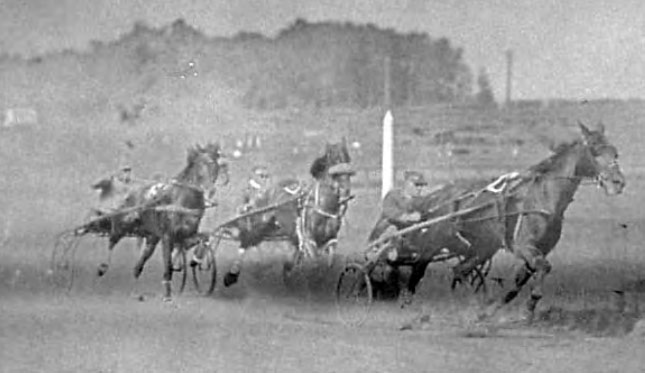
A half-mile racetrack, completed in July 1897, marked the start of Plymouth’s long racing tradition. Its opening featured a harness race, bicycle races, and foot races.
- First prize for the horse race: $25
- First prize for the foot race: an umbrella (much to the runners’ disappointment!)
In 1900, Plymouth almost shut down to give everyone a chance to attend. Motorcycle racing moved in to compete with the horses in 1909, and spectators began to attend the fair in horseless carriages. In 1910, a special gate was opened just for automobiles to prevent spooking of the horses.
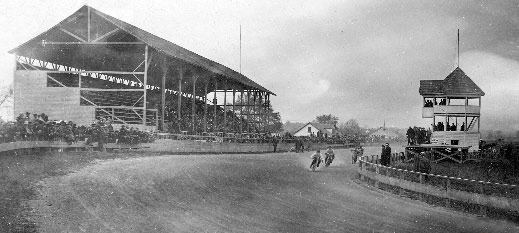
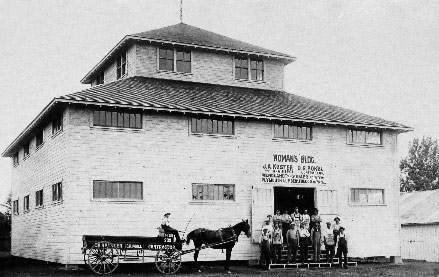
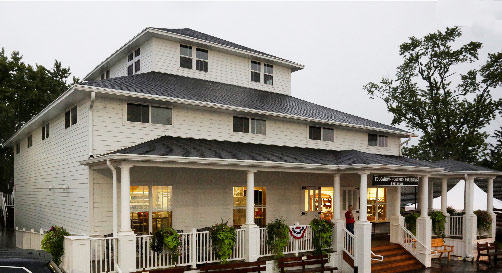
A special parade of autos was held one year with the top prize of $11 to be distributed between the top five cars. Only four winners claimed a prize. The fifth became bogged down in the mud somewhere in the country. A model of a country home lighted by electricity was the big attraction in 1912, and in 1914 homemakers learned how electricity could keep butter and cheese fresher. An airship visited the fair in 1919 along with an exhibit on torpedoes. Advertisements from 1914 boasted, “The Six Moroccos, also known as the Wild Moors, Whirlwinds of the Desert, are here to introduce a new show, startling and daring, with Oriental juggling, dancing and soudanic drills.” Soudanic referred to performers from Timbuctoo. It goes on to discuss the Riding Davenports, who were “peerless and scintilant, performing the most daring feats of bareback riding ever.” In 1916 the Education-Household building was constructed at a cost of $2543. The building was idea of the Plymouth Women’s Club. The group raised funds so they could show off their finest stitchery, baking and canning.
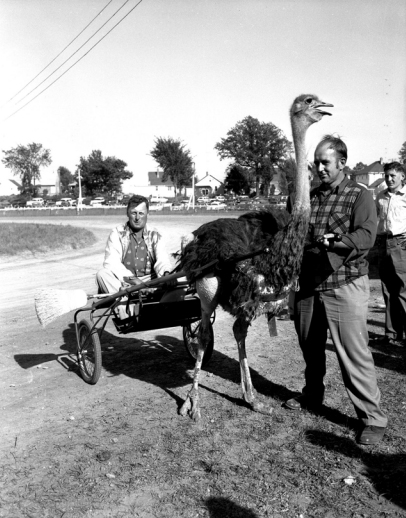
The 1910s through the 1930s were considered the glory days of the fair. Heated political speeches, Wild West shows, horseless carriage parades and fortune telling gypsies enlivened the event. Airplane stunt shows became a big thing during the late 1920s as did harness races of trotters and pacers.Stunt fliers entertained crowds at the 1927 fair, the final day of which was marred by the burning of a large cross, evidently by local Ku Klux Klan members.The 1937 fair had WHBL broadcasting live from the Midway. Featured performers and exhibitors were interviewed. Musicians performed; the German Beer Garden of the Air, sponsored by Jung’s, was a highlight. Leonard Kranendonk, famed local baritone and accordion player entertained with a selection of his favorite opera pieces. Stock car racing replaced harness races in the late 1940s and September 1955 brought ostrich racing to Plymouth’s fair.
In 2010 the the Education and Household Building was landmarked by the Plymouth Historical Society and the City of Plymouth. In August of 2016, the fair celebrated the 100th anniversary of the building.
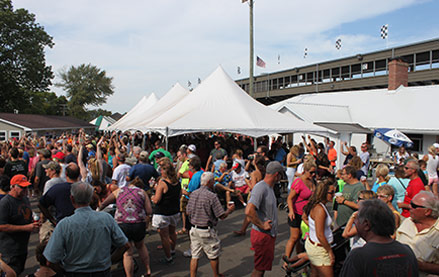
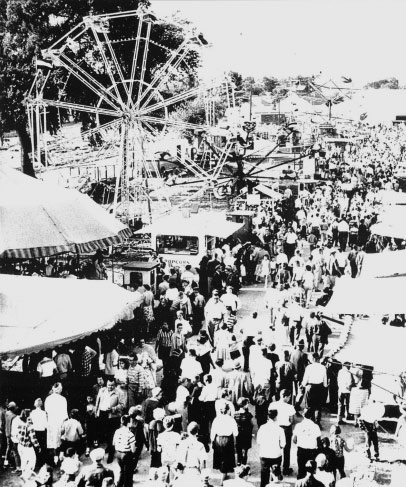
Today, we see everything. Farm machinery, sewing projects, champion pigs, carnival rides, live music and stock car racing . There is something for everyone to eat, from corn dogs to cotton candy, egg rolls to walking tacos, corn on the cob to our famous steak sandwich on a Sheboygan hard roll.